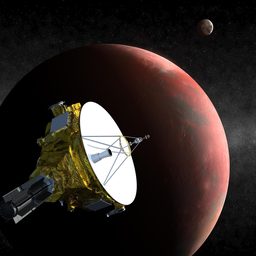
New Horizons
NASA mission that made the first close study of Pluto in 2015 and flew past Arrokoth, the most distant object explored up close, in 2019.
Image: NASA/Johns Hopkins University Applied Physics Laboratory/Southwest Research Institute
New Horizons is the NASA spacecraft that made the first close exploration of Pluto, flying past the dwarf planet and its moons on 14 July 2015.[1] It was the first mission in NASA's New Frontiers program.[1]
The journey
New Horizons launched on an Atlas V rocket from Cape Canaveral, Florida, on 19 January 2006.[1] By the time it reached Pluto, more than nine years later, it had traveled farther and for longer than any deep space spacecraft before it.[1] Along the way it photographed Jupiter's moons Io, Europa and Ganymede.[1]
Pluto
Images from the flyby revealed a vast heart-shaped glacier of nitrogen ice, named Sputnik Planitia, about 1,000 km wide and the largest known glacier in the solar system.[1]
Arrokoth
After Pluto, the team redirected the spacecraft toward a small object in the Kuiper Belt, and on 1 January 2019 New Horizons flew past Arrokoth, the most distant object ever explored up close.[1] Arrokoth is about 35 km long, made of two lobes joined together; the larger lobe is flattened like two lenses placed back to back.[1]
By 2024 New Horizons was 60 times as far from the Sun as Earth is, twice as far out as Pluto was during the flyby.[1]
Milestones
- January 19, 2006Launch on Atlas V
- July 14, 2015Flyby of Pluto
- January 1, 2019Flyby of Arrokoth
Sources
- [1]NASA, New Horizons — science.nasa.gov, retrieved October 26, 2026