Lucy
NASA mission flying past a record number of asteroids, including the Trojans that share Jupiter's orbit, from 2023 to 2033.
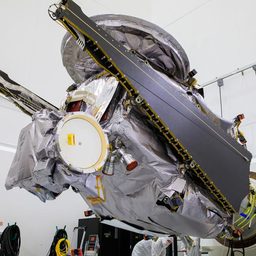
Image: NASA/Glenn Benson
Lucy is a NASA mission to the Trojan asteroids, two swarms that share Jupiter's orbit around the Sun, and the first spacecraft to explore them.[1] It is planned to fly past a record number of asteroids: three in the main asteroid belt and eight Trojans.[1]
Why the Trojans
The Trojans are held in stable orbits associated with Jupiter but not close to it.[1] Models of planet formation suggest they are remnants of the same material that formed the outer planets, which makes them time capsules from the birth of the solar system more than four billion years ago.[1]
The flybys
Lucy launched on 16 October 2021.[1] Its flybys, in order, with dates in US Eastern time:
- Dinkinesh, in the main belt, on 1 November 2023, where Lucy found a small moon, Selam, itself made of two touching lobes.[1]
- Donaldjohanson, in the main belt, on 20 April 2025.[1]
- Eurybates and its moon Queta, on 11 August 2027, the first Trojan visit.[1]
- Polymele and its moon, on 14 September 2027.[1]
- Leucus, on 18 April 2028, and Orus, on 11 November 2028.[1]
- Patroclus and its partner Menoetius, a pair of Trojans orbiting each other, on 3 March 2033.[1]
The spacecraft
Each of Lucy's two solar panels is more than 7 m across.[1] Its instruments and its 2 m high-gain antenna are mounted on the spacecraft's body.[1]
Milestones
- October 16, 2021Launch on Atlas V
- November 1, 2023Flyby of asteroid Dinkinesh, discovering its moon Selam
- April 20, 2025Flyby of asteroid Donaldjohanson
- August 11, 2027Flyby of Trojan asteroid Eurybates and its moon Queta
- September 15, 2027Flyby of Trojan asteroid Polymele
- April 18, 2028Flyby of Trojan asteroid Leucus
- November 11, 2028Flyby of Trojan asteroid Orus
- March 3, 2033Flyby of the binary Trojans Patroclus and Menoetius
Sources
- [1]NASA, Lucy — science.nasa.gov, retrieved October 26, 2026