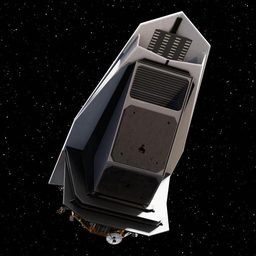
NEO Surveyor
NASA's infrared space telescope designed to find asteroids and comets that could be hazardous to Earth, planned for launch no earlier than September 2027.
Image: NASA/JPL-Caltech
NEO Surveyor is the first space telescope specifically designed to find asteroids and comets that could be hazardous to Earth.[1] It builds on NASA's NEOWISE space telescope and is scheduled to launch no earlier than September 2027.[1]
Why infrared
Many near-Earth objects are hard to see from the ground. Dark asteroids and comets reflect little visible light, but they glow in infrared light as the Sun warms them, and NEO Surveyor's infrared detectors are built to pick up that glow.[1] From space it can also look for objects that approach from the direction of the Sun, or that lead or trail Earth in its orbit, where sunlight hides them from telescopes on the ground.[1]
The goal
NASA's goal is to find at least 90% of near-Earth objects 140 m and larger, a size whose impact could devastate a wide area.[2] Fewer than half of the estimated 25,000 such objects had been found when NASA last updated its count.[2] NEO Surveyor is designed to discover at least 90% of asteroids 140 m and larger.[3]
Warning time is what makes deflection possible: the more years of notice, the more likely a mission like DART could prevent an impact.[3] Beyond defense, scientists will use NEO Surveyor's data to learn more about how the solar system evolved.[1]
How a new asteroid is found and followed is covered in From discovery to defense.
Milestones
- September 2027 expectedLaunch on Falcon 9
Dates marked expected are agency estimates.
All missions and what each does nextSources
- [1]NASA, NEO Surveyor — science.nasa.gov, retrieved October 26, 2026
- [2]NASA, Near-Earth Object Observations Program — nasa.gov, retrieved October 26, 2026
- [3]NASA, From Impact to Innovation: A Year of Science and Triumph for Historic DART Mission — nasa.gov, retrieved October 26, 2026
Related
- Planetary defenseHow DART moved an asteroid in 2022, and how Hera, NEO Surveyor and Ramses build on it to find threats earlier and deflect them reliably.
- From discovery to defenseHow a moving speck of light becomes a named asteroid with a known orbit, and who acts if one is ever found on a collision course.