Phaethon
The rocky asteroid behind the Geminid meteor shower, which passes closer to the Sun than Mercury and brightens as it does.
At a glance
- Size
- ~5–6 km — one of the largest known PHAs
- Impact risk
- Not on NASA's impact-risk list
Missions to Phaethon
Dates marked expected are agency estimates.
From discovery to the flyby
- Between April 2028 and March 2029 expectedLaunch (H3, shared with Ramses)DESTINY+
- In 2029 expectedFlyby of Apophis, a rehearsal for PhaethonDESTINY+
- Between April 2030 and March 2031 expectedFlyby of Phaethon, parent of the GeminidsDESTINY+
Dates marked expected are agency estimates.
Most meteor showers come from comets. The Geminids, which peak in mid-December and are among the best and most reliable showers of the year, come instead from an asteroid: 3200 Phaethon.[1] Under perfect conditions, about 120 Geminid meteors an hour can be seen at the peak, each one a fragment of debris from Phaethon's orbit burning up in Earth's atmosphere.[1]
Discovery and size
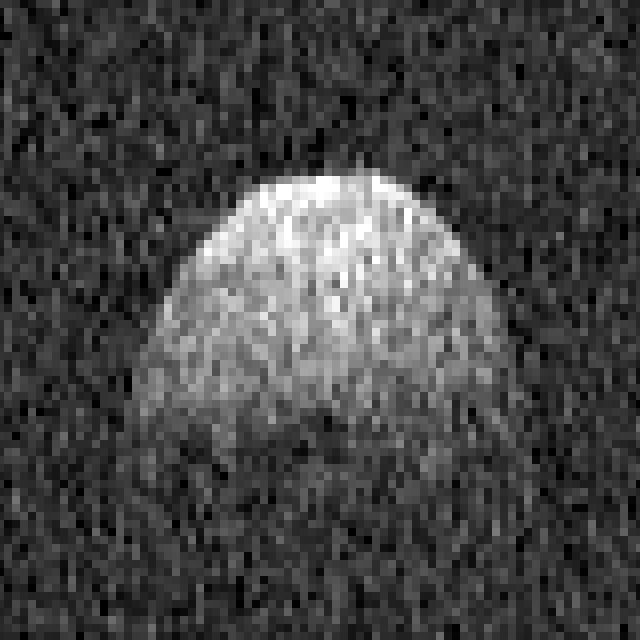
Phaethon was discovered on 11 October 1983 by NASA's Infrared Astronomical Satellite, IRAS.[2] The astronomer Fred Whipple recognized it as the source of the Geminids.[1] Size estimates range from about 5 km to 6 km, so it is one of the larger potentially hazardous asteroids known.[1][2] Radar images from the Arecibo Observatory in December 2017 showed a roughly ball-shaped body with a large depression near its equator.[2] At that pass, on 16 December 2017, Phaethon came within about 10.3 million km, some 27 times the distance to the Moon; it will not come closer until 2093.[2]
An asteroid that behaves like a comet
Phaethon's elongated orbit, which takes 524 days, carries it well inside the orbit of Mercury, where the Sun heats its surface to about 750 °C.[3] Near the Sun it brightens, as comets do, although any ice near its surface would have been baked away long ago.[3] A 2021 study proposed that sodium in its rock vaporizes and vents through cracks, enough to brighten it and to eject small pieces of rock; this would also explain why Geminid meteors contain little sodium.[3] Scientists still debate whether Phaethon is best described as an asteroid or as a dead or rocky comet.[1]
A mission to fly past it
Japan's DESTINY+ mission will make a high-speed flyby of Phaethon and study interplanetary dust, which brings carbon and organic matter to Earth and of which Phaethon is one source.[4] It is aiming for launch in Japan's fiscal year 2028, sharing an H3 rocket with ESA's Ramses spacecraft, and it will first fly past Apophis as a rehearsal.[4][5]
Sources
- [1]NASA, Geminids — science.nasa.gov, retrieved October 26, 2026
- [2]NASA Jet Propulsion Laboratory, Arecibo Radar Returns with Asteroid Phaethon Images — jpl.nasa.gov, retrieved October 26, 2026
- [3]NASA Jet Propulsion Laboratory, Fizzing Sodium Could Explain Asteroid Phaethon's Cometlike Activity — jpl.nasa.gov, retrieved October 26, 2026
- [4]JAXA Institute of Space and Astronautical Science, DESTINY+ — destiny.isas.jaxa.jp, retrieved October 26, 2026
- [5]JAXA Institute of Space and Astronautical Science, Deep Space Exploration Technology Demonstrator DESTINY+ — isas.jaxa.jp, retrieved October 26, 2026
Related
- How close, how big, how oftenWhat a lunar distance is, why asteroid sizes are given as ranges, and how often asteroids of each size pass Earth or hit it.
- ApophisApophis passes Earth on 13 April 2029, closer than geosynchronous satellites and visible to the naked eye. What will happen, where to see it, who is going.