Asteroids
Asteroids are rocky remnants left over from the formation of the solar system about 4.6 billion years ago.[1] Those whose orbits come near Earth's are tracked by survey telescopes and checked automatically for any chance of impact over the next 100 years.[2] No known asteroid larger than 140 m has a significant chance of hitting Earth in that time.[3] A few small ones are even captured by Earth's gravity for a while as minimoons, temporary second moons too faint to see. The largest asteroid, Ceres, the first one found and called an asteroid for many years, is also a dwarf planet.[4]
Happening now
Close approach
Empire State Building-sized asteroid 218017
42 LD · ~451 m
November 14, 2026 (UTC)
Close approachBrachiosaurus-sized asteroid 2026 VV15
4.1 LD · ~21 m
November 14, 2026 (UTC)
Close approachBrachiosaurus-sized asteroid 2026 VV8
3.6 LD · ~19 m
November 14, 2026 (UTC)
Close approachGateway Arch-sized asteroid 2020 XM1
28 LD · ~167 m
November 16, 2026 (UTC)
Notable
 ApophisApophis passes Earth on 13 April 2029, closer than geosynchronous satellites and visible to the naked eye. What will happen, where to see it, who is going.
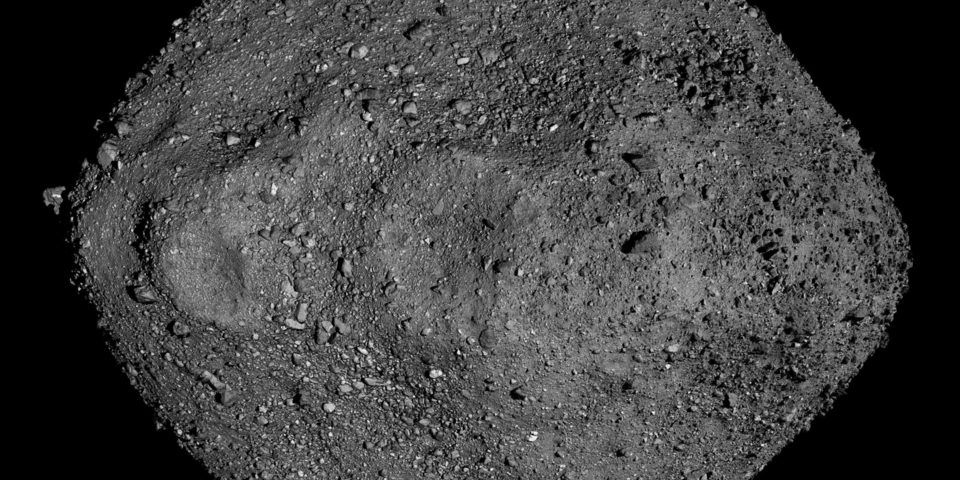
 BennuThe asteroid NASA's OSIRIS-REx sampled and brought to Earth in 2023, and one of the two most hazardous known asteroids.
 Didymos and DimorphosThe double asteroid whose small moon, Dimorphos, NASA's DART spacecraft struck in 2022, the first time humans moved a celestial object.
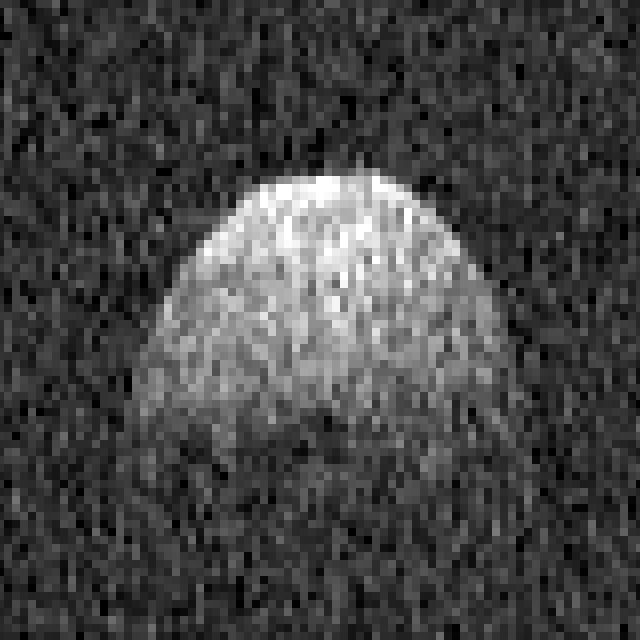 PhaethonThe rocky asteroid behind the Geminid meteor shower, which passes closer to the Sun than Mercury and brightens as it does.
 ErosThe first near-Earth asteroid ever found, in 1898, and the first asteroid a spacecraft orbited and landed on.
 ItokawaThe small rubble-pile asteroid from which Japan's Hayabusa returned the first asteroid sample in 2010, linking common meteorites to their source.
 RyuguThe dark, top-shaped asteroid from which Japan's Hayabusa2 brought back 5.4 g of material in 2020, rich in water-bearing minerals and organic molecules.2006 RH120The first mini-moon ever found. A few meters across, 2006 RH120 was captured by Earth in mid-2006, looped around us for about a year and left in mid-2007.2020 CD3The best-studied mini-moon. 2020 CD3, a rock about 1.2 m across, orbited Earth from September 2017 to March 2020 and was found only in its last weeks.2022 NX1A mini-moon that keeps coming back. 2022 NX1 was briefly bound to Earth in January 1981 and June 2022, and is due to return as an orbiter in December 2051.2024 PT5The mini-moon of autumn 2024. A rock about 10 m across, 2024 PT5 was bound to Earth from 29 September to 25 November 2024 and is probably a piece of the Moon.2026 QQ8Earth's mini-moon of 2026. 2026 QQ8, a rock probably about a meter across, is temporarily bound to Earth and passes 3.5 lunar distances away on 13 December.
Guides
- Impact riskHow NASA's Sentry system finds possible asteroid impacts, what the Torino and Palermo scales mean, and why the odds usually fall to zero.
- How close, how big, how oftenWhat a lunar distance is, why asteroid sizes are given as ranges, and how often asteroids of each size pass Earth or hit it.
- From discovery to defenseHow a moving speck of light becomes a named asteroid with a known orbit, and who acts if one is ever found on a collision course.
- Planetary defenseHow DART moved an asteroid in 2022, and how Hera, NEO Surveyor and Ramses build on it to find threats earlier and deflect them reliably.
- Minimoons: Earth's temporary second moonsMini-moons are small asteroids that Earth's gravity holds for weeks or years before they slip away. What they are, how they are found, and the ones we know.
Terms
All terms in the GlossarySources
- [1]NASA, Asteroid Facts — science.nasa.gov, retrieved October 26, 2026
- [2]NASA/JPL Center for Near-Earth Object Studies, Sentry: Earth Impact Monitoring — cneos.jpl.nasa.gov, retrieved October 26, 2026
- [3]NASA, Near-Earth Object Observations Program — nasa.gov, retrieved October 26, 2026
- [4]NASA, Ceres: Facts — science.nasa.gov, retrieved November 5, 2026