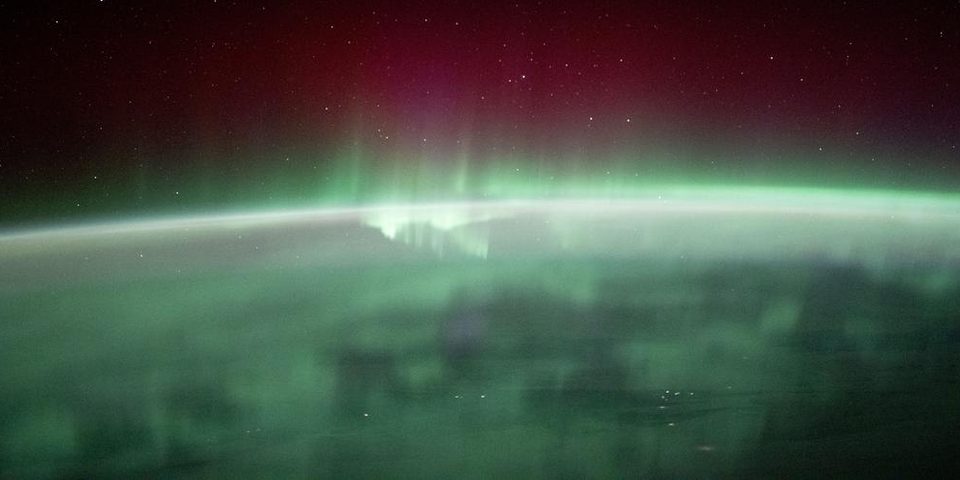
Sun & aurora
Image: NASA
The Sun's activity rises and falls on a cycle of about 11 years, and its largest eruptions can disturb Earth's magnetic field.[1] During a geomagnetic storm the aurora, normally confined to high latitudes, can spread much closer to the equator.[2] NOAA rates these storms from G1 to G5, and each level comes with how far from the poles the aurora has typically been seen.[3]
Guides
- Aurora: how far south and whenWhat causes the aurora, how the Kp index and NOAA's G scale predict how far from the poles it can be seen, and how to give yourself the best chance.
- Solar stormsWhat solar flares and coronal mass ejections are, how NOAA rates their effects on Earth, and how the 11-year solar cycle shapes them.
Terms
All terms in the GlossarySources
- [1]NOAA Space Weather Prediction Center, Sunspots/Solar Cycle — swpc.noaa.gov, retrieved October 26, 2026
- [2]NOAA Space Weather Prediction Center, Aurora — swpc.noaa.gov, retrieved October 26, 2026
- [3]NOAA Space Weather Prediction Center, NOAA Space Weather Scales — swpc.noaa.gov, retrieved October 26, 2026