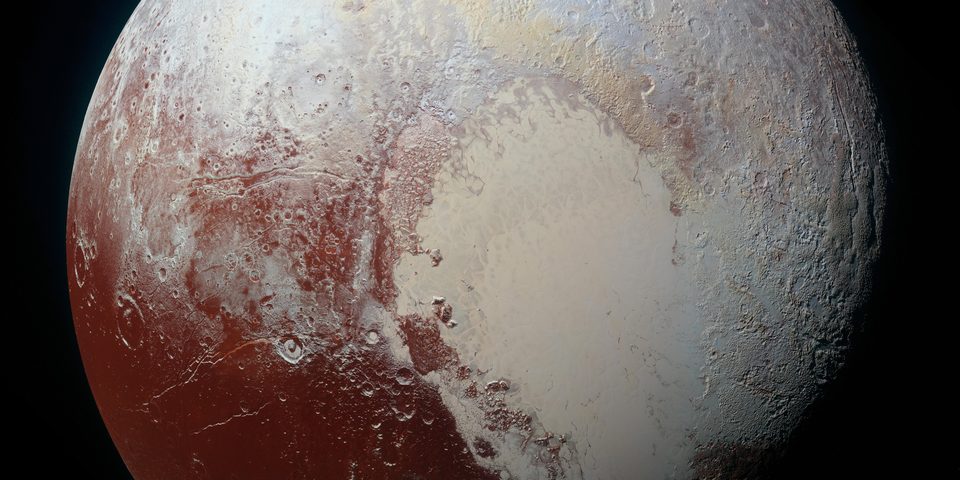
Dwarf planets and the outer solar system
Image: NASA/Johns Hopkins University Applied Physics Laboratory/Southwest Research Institute
Beyond Neptune lies a belt of icy worlds left over from the birth of the solar system, and among them the largest are the dwarf planets: bodies big enough for their own gravity to make them round, but not big enough to sweep their orbits clear.[1] The International Astronomical Union recognises five, Ceres, Pluto, Haumea, Makemake and Eris, and says perhaps more than a hundred more are waiting to be found.[1] The belt itself begins at Neptune's orbit, about 30 astronomical units from the Sun, and astronomers think it holds millions of small icy objects.[2] New survey telescopes are now finding them in numbers: in October 2026 the Rubin Observatory announced its first dwarf-planet candidate, 2026 ED138, hidden until then in a crowded part of the sky.[3] The guide What is a dwarf planet? explains the definition and the candidates; The Kuiper belt and beyond describes the region and how its objects are found.
Notable
Guides
- What is a dwarf planet?The definition that made Pluto a dwarf planet in 2006, the five the IAU recognises, why the list grows so slowly, and the candidates waiting to join it.
- The Kuiper belt and beyondThe ring of icy worlds past Neptune, the scattered disk and the Oort cloud beyond it, how many objects are known, and how new ones are found.
Terms
All terms in the GlossarySources
- [1]NASA, Pluto & Dwarf Planets — science.nasa.gov, retrieved November 5, 2026
- [2]NASA, Kuiper Belt: Facts — science.nasa.gov, retrieved November 5, 2026
- [3]NSF–DOE Vera C. Rubin Observatory, NSF–DOE Vera C. Rubin Observatory Reveals Its First Dwarf Planet Candidate in Our Solar System — rubinobservatory.org, retrieved November 5, 2026